After Writing: How AI Revives the Age of Logos/Orality
Presented by:
Cengiz Sisman, University of Houston Clear Lake
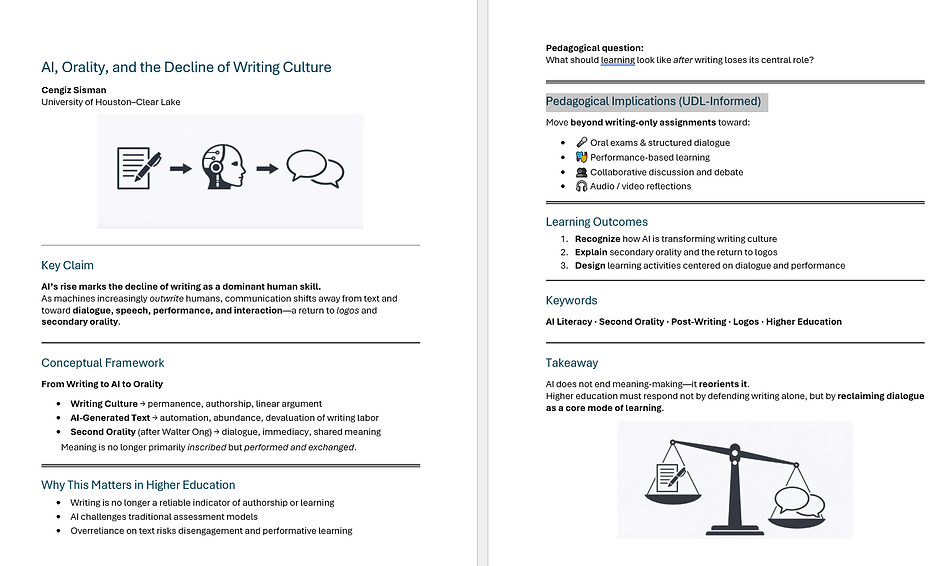
AI’s rise marks the decline of writing culture, as machines outwrite humans. This shift heralds a return to orality—reviving logos through dialogue, speech, and interactive expression.
Keywords:
AI Literacy, Second Orality, Post-writing
Abstract:
The rise of artificial intelligence marks a turning point in the history of communication. As machines become increasingly skilled at generating text, the centrality of human writing begins to fade. This transformation signals not merely automation but a return to logos: a renewed orality grounded in dialogue, performance, and immediacy. In this emerging landscape, meaning is spoken rather than inscribed, shared rather than stored. For educators, this shift demands a rethinking of classroom practices—moving beyond traditional writing assignments toward tasks that privilege oral exchange, collaborative performance, and embodied forms of learning.
Outcomes:
1. Recognize how the rise of artificial intelligence is transforming writing culture.
2. Analyze the concept of “secondary orality” and return of logo-centric culture.
3. Develop innovative approaches to teaching that emphasize dialogue, performance, and oral expression.
Hear it from the author:

Transcript:
Hi. My poster explores how artificial intelligence marks a turning point in the history of communication. As AI becomes increasingly capable of producing polished and coherent text, writing is losing its status as a uniquely human skill. This development does not simply automate writing; it decenters it as a primary marker of authorship, learning, and intellectual labor.
This shift signals a return to logos or a form of oral traditions that dominated knowledge transmission before the rise of writing culture some five to six thousand years ago.
For higher education, this transformation poses a significant pedagogical challenge. If writing can no longer reliably demonstrate learning, course design must be rethought. Rather than doubling down on text-based or online assignments, this moment invites experimentation with oral exams, structured dialogue, and collaborative performance, aligned with the principles of Universal Design for Learning.
My central claim is not that writing disappears, but that it loses its monopoly. In an AI- saturated environment, reclaiming dialogue as a core educational practice may be one of the most effective ways to sustain meaningful, human-centered learning.
References:
Colella, S. (2025). “The language of the digital air”: AI-generated literature and the performance of authorship. Humanities, 14(8).
Emigh, R. J. (2024). Whither digitality? The relationship between orality, literacy, and digitality, past and present: From spoken traditions to digital media. Annual Review of Sociology, 50, 1–24.
Re-embracing orality in digital education: The pedagogical affordances of podcasting in the era of generative AI. (2024). Frontiers in Education, 32.